Best Car Deals Near You: How Local Competition Helps Buyers Save
Best Car Deals Near You: How Local Competition Helps Buyers Save
Local competition among dealerships can be one of the most effective tools a buyer has to lower the purchase price, improve financing terms, and reduce total transaction costs. This article explains how local inventory, pricing dynamics, financing offers, trade-in strategies, and out-the-door math interact — and gives practical steps buyers can use today to find the best car deals near them.


Why local competition matters
Fact: Dealerships in the same market compete for the same customers and for the same pool of local inventory. That competition affects how aggressively they price new and used cars, how willing they are to negotiate on financing and fees, and which incentives they advertise.
Analysis: When multiple dealers have similar models in stock, buyers can use competing offers to push net price down and to extract better ancillary terms such as lower document fees or bonus accessories.

Inventory and pricing: read the local supply signals
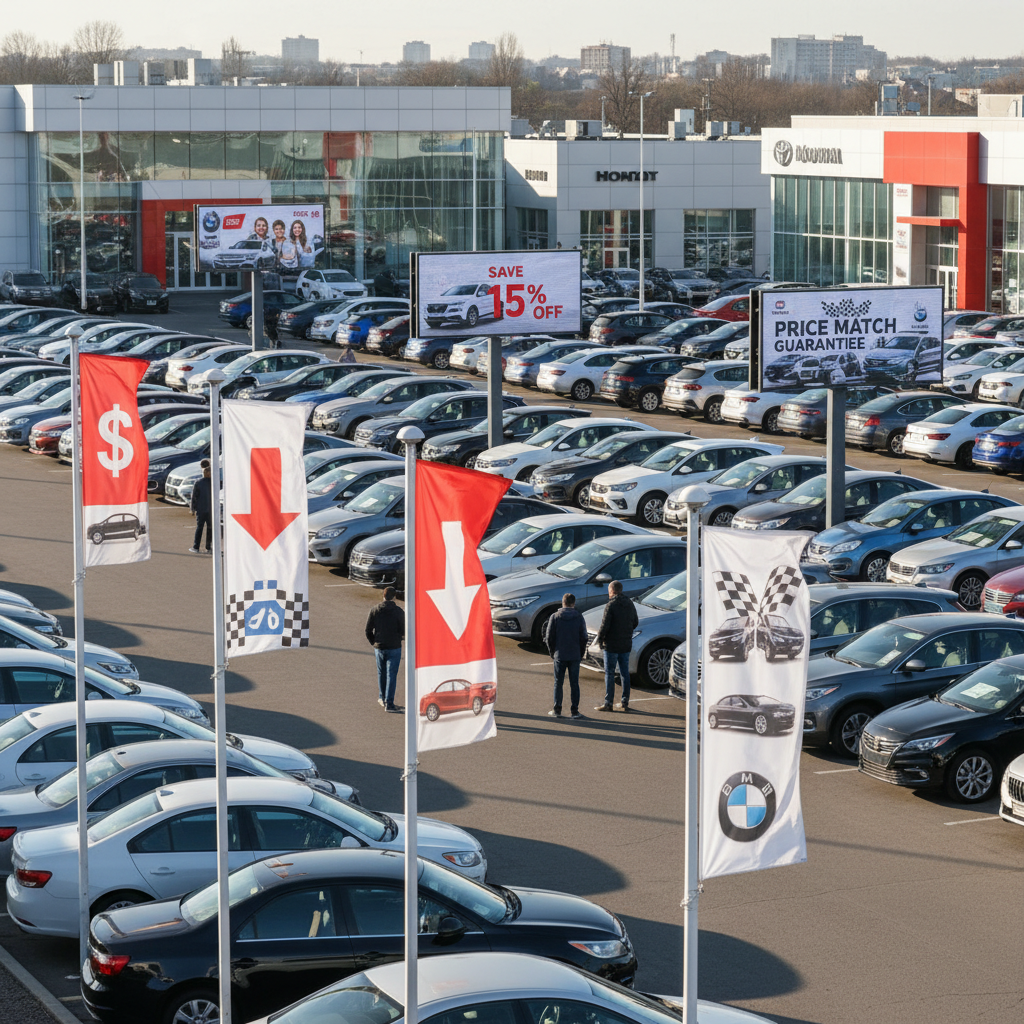
Inventory depth drives bargaining leverage. A dealer with three identical SUVs in stock will generally be more willing to move price than a dealer with one last unit and strong demand.

How to interpret inventory data
- High local availability usually means more discounts and manufacturer incentives.
- Low availability tends to push dealers toward hold-the-line pricing, fewer discounts, and more emphasis on add-on margin.
- Compare identical trims, options, and colors — differences in comparables will change the effective discount.
Practical data point (example): If the advertised price difference between two local dealers is $1,500 on a $35,000 model, that is a tangible negotiation lever — it represents roughly 4.3% of MSRP and can be used to request match-and-better offers or additional concessions.
Financing: use competition to lower APR and fees
Fact: Dealer-arranged financing and outside loans are both available; dealers may mark up the finance rate above the buy rate they receive from lenders.
Analysis: When local dealers compete, they sometimes offer promotional APRs or buy-rate buy-downs to win the sale. Bringing a pre-approval and a competing in-market loan offer gives you bargaining power.
Example calculation — why a small rate change matters
Consider a $30,000 loan over 60 months. At 4.00% APR, the monthly payment is about $552. At 5.00% APR, the monthly payment increases to about $566 — a $13–$14 difference per month and roughly $800 extra over the life of the loan. Small rate improvements from local competition can therefore save hundreds.
Trade-ins: separate the negotiations
Fact: Trade-in value and purchase price are distinct components of the transaction. Treat them separately for best outcomes.
Analysis: Dealers will sometimes improve a trade-in offer to close a deal, but that improvement may be offset by a higher purchase price. Getting multiple local appraisals and getting a private-sale estimate gives you the factual baseline to negotiate.
Practical approach
- Get an online appraisal estimate and two in-person trade-in offers from nearby dealers.
- Ask dealers to quote trade-in value in writing and to show how it factors into the total deal.
- Compare a dealer trade-in offer to an estimate for a private sale; a private sale often yields more, but costs time and effort.
Total transaction costs: the out-the-door number
Fact: The advertised price rarely equals the final amount you pay. Sales tax, registration, state fees, dealer documentation fees and optional add-ons all affect the final cost.
Analysis: Local competition can drive down the base price and also create pressure to waive or reduce dealer-added fees. The most reliable comparison is the “out-the-door” (OTD) price: the single number that includes all mandatory charges.
Checklist to compare out-the-door costs
- Obtain written OTD prices from at least three nearby dealers.
- Confirm sales tax rate and registration fees specific to your county or state.
- Ask for a line-by-line invoice that lists the base price, rebates/incentives, trade-in credit, fees, and add-ons.
- Negotiate add-ons (paint protection, alarm systems) separately and accept only what you want.
Practical negotiation steps to use local competition
- Survey inventory at nearby dealerships and identify 2–4 direct comparables.
- Request written OTD quotes and financing terms from each dealer.
- Bring a bank pre-approval and a clear trade-in estimate.
- Solicit a written competing offer from one dealer and ask others to match or beat it.
- Close on the offer with the best OTD price and the most favorable financing and trade-in terms; confirm all terms in writing before signing.
Bottom line
Local competition can materially lower the total cost of buying a vehicle — but it requires disciplined comparison, a focus on out-the-door pricing, and careful separation of purchase price, financing, and trade-in. Facts about fees and inventory are verifiable; the analysis lies in how you use that information. Follow the steps above to convert local dealer rivalry into real savings.